Showing posts with label 1/2400th. Show all posts
Sunday, 6 January 2013
1/2400th ACW Naval: Some recent additions....
Thought I'd share some photos of a few recent acquisitions from the nicely re-vamped online shop over at Tumbling Dice; in particular from their 1/2400th naval ranges:
http://www.tumblingdiceuk.com/product-category/12400-naval
The new interface makes it much easier to shop with them, and more importantly, the online catalogue now lists some miniatures that although available for purchase for some time, were not previously shown in the online listings - the ACW ironclads in this post come under that category.
There are also some new models available in the already excellent Victorian Naval Range, so worth a look if you haven't visited recently.
To kick things off then, from their pack ASV60, the Confederate CSS Albermarle and the CSS Manassas:
As with the majority of the range, the models in and of themselves are nicely proportioned and fit well into their separate bases, however, there are I believe problems with historical accuracy that similarly affect other ships as depicted in the ACW range.
Whilst the Manassas has a great domed shape, characteristic of the original, it appears with only a single funnel; I have certainly seen depictions that have her with two - I don't know enough about the period to really be a good judge of which is correct; but obviously if you were expecting two, then a bit of conversion would be necessary:
http://www.history.navy.mil/photos/sh-us-cs/csa-sh/csash-mr/mansas-m.htm
http://www.cityofart.net/bship/manassas.html
The Albermarle is pretty decent, although I suspect that the rear of the casemate was sloped at a similar angle to the front face in the original, whilst this model has it flat.
Next up the pair of vessels from ASV50, the USS Roanoke and USS Keokuk:
The larger of the pair looks to me a pretty decent facsimile of the original at this scale:
http://en.wikipedia.org/wiki/File:Uss_Roanoke_1855_Ironclad.jpg
whilst the Keokuk, I think has some problems with the turrets - I think in the original these had a noticeable slope to the armoured sides, giving almost a conical aspect that differs from the straight ones in this miniature:
http://www.history.navy.mil/photos/sh-usn/usnsh-k/keokuk.htm
That is not to say, however, that these are necessarily bad models, they are good value reproductions in the spirit of the originals, and given that I would tend to also want to use them as part of wider, VSF- style campaigns, don't particularly bother me, but might offend the purist or dedicated ACW fan...
As to their sizes, they both sit up well against other craft from the range; here a sternwheel tinclad:
and also the Roanoke against a slightly converted Monadnock class monitor in the colours of the Peruvian Navy:
Finally we have the rather smaller craft that populate the pack ASV90, that contains six assorted Spar Torpedo Boats and 'Davids', two of each type; from the right the submersible, the spar torpedo boat and then a picket boat:
These are nicely modelled, and give enough variety to use them in a number of differing guises; I think both a CSS David and a CSS Hunley would be possible at this scale, whilst the picket boat type trailing a dinghy is generic enough to be of use as a number of different craft - one very small criticism is that the spar torpedo apparatus is not actually visible out front in the sculpts themselves.
Overall, then, I'm happy enough with these few additions to my VSF fleets, a project that I am hoping to firm up somewhat in the course of this year, and give me the option for the odd ACW battle if I am not too fussy about the exact historical types....
Certainly, as I would like to field a few 'what if' vessels like the CSS Scorpion from ASV57, here menaced by lots of pesky craft, I'm not going to be too much of a stickler for historical accuracy!
Labels:
1/2400 ACW Naval,
1/2400th,
Product Reviews,
Tumbling Dice
Thursday, 9 December 2010
Small Scale Naval: Generic Dockyard
The recent successful construction of Fort Humpter had me thinking what else I could add in terms of scenics for the various Small Scale Naval projects that I currently have under my belt. Given that this is a range that now covers everything from 1/4800th Napoleonic to 1/3000th Pre-Dreds via 1/2400th Pacific War and now ACW Monitors, I wanted to have something that was generic enough to be of use to all, and whilst it might horrify scale purists, would make use of various buildings I had collected in scales between 1/3000th to 1/900th.
I decided to go for a Dockyard scene that eventually could sit on some coastline terrain pieces, and would allow the depiction of various eras in a general way.
The starting point, as always, was an amalgam of various bits of card and scraps, to be initially populated by some dock buildings that I obtained long ago from Navwar when ordering for the 1/3000th Boxer Rebellion Naval project, alongside some miscellaneous spars, timber and boxes, etc from Langton Miniatures in their 1/1200th range:
Navwar's 3MH5/5a Sailing Era strips of Store Houses and extensions, as well as the 3MH6/6a Workshops, made for a good base of various types of building, placed amidst the detritus provided from Langton's M47 Dockyard Misc. pack - overall not mixing too badly in purely visual terms.
These base pieces were then reinforced by the following motley crew:
In the foreground, we have three of Irregular Miniature's IKS10 2mm single house models, here with a 'Tudorised' paintjob that was originally for the 2mm ECW project.
In the centre, from Navwar's 1/3000th Harbour Pieces, the 3MH7/7a 20th Century Factory or Warehouse, and the Oil Tanks Group, which are somewhat basic, but paint up well; and finally in the rear, some of the smaller items from Langton's 1/1200th buildings range, I think here a combination of his M5 and M7 packs.
Adding in these in different combinations, then allows the 'feel' of the Docks to change with the era......
From Sail and Steam:
via Steam:
to Coal, Oil, and the dawn of the 20th Century:
At least that is the plan!
I've also got some small Dockyard cranes and a Coaling Dock from I forget exactly which manufacturer, (Scotia?) and these also might see the light of day once I can extract them from the depths of the Lead Mountain, which should really ensure a good span of possible uses for this scenic base.
Monday, 22 November 2010
ACW Naval: Fort Humpter ready for duty!
After some final painting, I am pleased to report that the scratch-built Fort Humpter is ready for service alongside the 1/2400th Ironclads from Tumbling Dice.
A rather busy weekend meant that in all honesty, I didn't have time to make a start on the Monopoly Hotels-as-buildings glimpsed in the previous posts, but luckily remembered I had some 1/1200th Rod Langton buildings from the 2mm Quebec project; alright the scale is a bit suspect, but actually they don't look too bad in these shots posed for the camera.
Currently you'll note a hand-dawn Stars 'n Bars fluttering over the casemate, but by the cunning expediency of putting some blue-tac in the flagstaff base, I can easily swap this for 'Ole Glory depending on the fort's occupants.
I deliberately kept the level of detailing low, both as a matter of convenience, but also in the spirit of my usual quick scratch-build - I was going for a piece that would look the part, rather than being a fine scale model.
Too close an inspection would have the U.S. Engineers shuddering at the shoddy building techniques, but as it will be acting as a shot and shell magnet in most games, I don't really mind!
Of course, she could see service in a number of guises and postures, from the ACW to Aero and Aquanef - definitely a nice large target..... quick and fun to build, and certainly cheap!
Sunday, 14 November 2010
ACW Naval: Scratching about with Fort Sumter
"Fort Sumter has been fired upon......my regiment leaves at Dawn......" or something like that! Yes, the recent flurry of 1/2400th activity has seen me leaving my regular projects to the side, and concentrate on the flavour of the moment, here in the shape of a rough idea for a scratch-built Civil War Fort.
Probably more Fort Humpter than Sumter, I thought I'd sketch out a generic design based on the famous original, that might serve in some ship-to-shore action with the Tumbling Dice Ironclads.
A quick bit of internet searching found the U.S. National Parks Service site for the original, which has some very useful contemporary and modern views of the fort and its close compatriots, alongside some plan drawings:
A base width of 319 feet would see such a fort smaller in length than the large Kalamazoo Monitor seen in a previous post, so not much room for Columbiad guns, even if it is more to scale! As usual, therefore, I threw mathematics out the window, and went with what might look right.
I wanted to go the whole hog and have room for some scratch built artillery on the casemates, so I plumbed for a 120 x 120mm base card and freehanded a semblance of a fort as you see above.
Next up, some of that cell-centre packing card provided the start of walls, both internal and external:
and with the help of some blue-tac, we have, hey presto, the beginnings of something fairly suitable, I hope:
To give an idea of scale, I've thrown a TD Corvette and an ASV23 Stern Wheel Paddle Steamer into the photo, as it progresses, it should shape up to be quite a centrepiece for any Ironclad battle:
Alright, who am I kidding? It's not likely to go on when completed and win any model competition prizes, but will give a flavour of a contemporary fort for this new subsidiary project - obviously a long way to go yet, and I'm already distracting myself by sketching out some earthen batteries / artillery emplacements as we speak; but not bad so far for only twenty minutes or so of fiddling around - definitely more to come on this soon, so stay tuned!
Thursday, 11 November 2010
A 1/2400th Fleet for Bolivia and some ACW Naval
The recent kind generosity of David Crook (he of a Wargaming Oddyssey and Ogrefencer fame) in disposing of some of his Lead Mountain has seen a large influx of 1/2400th vessels into the shipyards at SteelonSand Towers.
This means that my own Lead Mountain has now grown exponentially (Grrr!), however in one fell swoop I now have enough ships to fill the gaps in both the Pacific War and Nemo vs The Militarist 'what-if' Fleets, as well has have a bit of fun with some ACW Ironclads. (Yay!)
I was lucky enough to get my hands on multiples of various types from Tumbling Dice across their Victorian and ACW Naval ranges, and this has seen me thinking along the lines of producing a Fleet for Bolivia that will sail alongside the historical ones of Chile and Peru.
When the Pacific War broke out, the dictatorial president of Bolivia, Hilarion Daza, apparently appealed for ships that would fight for his country, and was prepared to dispense Letters of Marque, in a legitimised Pirate style, to all-comers. Historically, of course, his offer does not seem to have been taken up, but I'm not going to let that hold me back!
I have a scenario in mind where ex-combatants from the American Civil War, including of course Confederate renegades, put together a rag-tag fleet of surplus war craft, and hot foot it South in search of glory and plunder.....
The ACW range from TD has its critics, and perhaps rightly so, given the slightly a-historical proportions of some of the sculpts, and it certainly suffers in comparison to its rival 1/2400th range from Panzerschiffe. There are some very good points made about this in an excellent Workbench Article over at TMP here:

Now given that I am not too concerned about the realism of these particular vessels, I will be quite happy to make good use of them, and have been putting the first coats to a number of different types, that might see double duty if I feel like putting on a strictly ACW game; below we see a collection of Monitors:
From the top, we have the USS Kalamazoo, the Dictator, the Monadnock and Agamenticus, and a slightly converted Monitor herself. The middle pair will be familiar to readers from my earlier conversions, and the larger two are similarly nice sculpts at this scale, but the iconic single turret craft does have a few problems that I did try to disguise. If anything, the TD model out of the packet has more in common with the historical Canonicus class, so I chopped the funnel and painted in some deck grilles as you see below:
The lower model is the 'as-it comes' version, which I will retain as a Bolivian Mercenary vessel, and the above may figure in an earlier sphere of combat. Another slightly problematic sculpt is the ASV53 Cairo Class vessels, that have more in common with a British Waterways Canal narrow boat than they do with the originals, but they will easily serve as a non-descript type in the pay of El Presidente Daza:
One sculpt that is closer to the original, is the generic Cotton Clad ASV59, which has a good stab at portraying, say, the CSS Stonewall Jackson, and the size of it also lends itself to a quick conversion or two - a karate chop on the rear end, and a funnel swap produces a relatively realistic looking USS Tin-clad, the Fort Hindman:
There's some nice illustrations of the various types as wargaming models of a slightly different calibre from the Thoroughbred Models' 1/600th catalogue:
Similar small-scale conversion work has been done on an ASV56 CSS Texas, to produce another generic type, perhaps an Arkansas or Charleston:
Well, Okay, I just filed off the ship's boats/small protuberances from the stern, but you get the picture! :-)
Perhaps the height of the TD range in terms of general appearance are the pairing available in the ASV58 Pack, CSS Nashvile and Missouri - definitely the best of the bunch:
These are all still a work in progress, and I've yet to glue the sail sets to various masts for the sailing vessels, but hopefully soon I'll be able to deploy full flotillas, whether historical or imagined for all three protagonists in the Pacific War, (Yay!) and all I have to do now is resist the temptation to suffer project-creep into the ACW itself (Grrr!).....
Labels:
1/2400 ACW Naval,
1/2400th,
Ironclads,
Pacific War 1879,
Tumbling Dice
Tuesday, 7 September 2010
Militarist Reinforcements Sighted! (Some progress....)
The Pacific War/Militarists vs. Nemo factions have recently seen some reinforcement after a kind of Summer hiatus here at SteelonSand Towers - I've promised myself that I will spend more time at the painting table, so hopefully the queue of naked lead should get some attention in the coming weeks, and I'll be able to organise things via the Blog.
The Tumbling Dice factory elves were put to work recently to supply a further order of 1/2400th Ironclad vessels for yours truly, principal amongst which were the ASV13 Screw Gunboats, to provide ships for both Chile and Peru, the ASV11 Screw Corvette to act as the Chilean Chacabuco and Esmerelda, and the ASV52 Monadnock to stand in as Peruvian Monitors.
As you can see both above and below, the Screw Corvette is a nice model with a full set of sails and also rat-lines integral to the sculpt, making it easy to paint in a hurry, which is my favourite style!
Obviously, the vessels here are still a work in progress, and have yet to be matched with their metal bases as provided, but I think you'll get the general idea of the level of detail and character available from this excellent range.
The Screw Gunboats pack provides three examples, which will be used as the Chilean Covadonga and Magellanes, as well as the Peruvian Pilcomayo:
These come pre-mounted to a small base part, in a manner reminiscent of the 1/4800th Napoleonic naval range of ships.
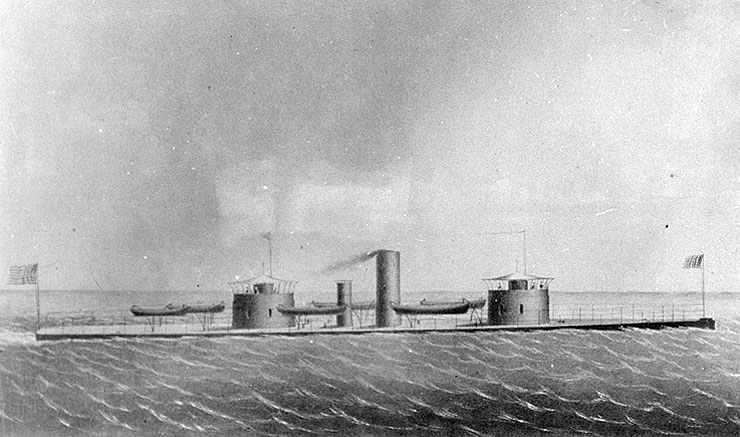
Next we spy the competing Corvette Union and the Ironclad Almirante Cochrane, with in the foreground, the first ex-American Monitor, the Mano Capac - converted here from the Monadnock models from TD:
The company does a number of Monitor types in various packs for the ACW period onward, but it is difficult to find one that exactly matches the Catawba class single turreted versions.
I therefore went with the ASV52 Monadnocks, as they are in the same general area in terms of length and breadth, whilst offering the chance of conversion with some judicious filing.
The large fore-funnel is removed entirely, along with the rearmost Dahlgren Gun Turret:
This approximates the look of the two Peruvian Monitors, and this scale is quite forgiving in terms of glossing over the more irreconcilable differences; these comparison shots show how the finished product comes out - compare them with the originals here:
Monadnock:
Mano Capac (USS Oneota):
http://maquina-de-combate.com/fotos_y_videos/Buques-en-la-Historia-del-Peru/Monitor_Manco_Capac_0003
I've yet to decide whether to attempt to add the Turret-top conning tower/sunshades seen on the originals - maybe I can ignore these, given how small and fiddly these would end up being!
The other issue is that of a suitable colour scheme -period photographs are notoriously difficult to interpret accurately, and I have seen any number of artist depictions from black to grey to white - perhaps I'll go for a different colour to differentiate the sister ship, the Atahualpa.
Anyway, whilst I shake off the accumulated rustiness of the Summer Holidays, why not take a look at some spirited recreations of the Pacific War originals in action:
and the real thing here:
Hasta luego!
Labels:
1/2400th,
Aquanef,
Ironclads,
Pacific War 1879,
Tumbling Dice
Monday, 21 June 2010
Aquanef: Pacific War 1879: Naval Strengths of the Militarists
Some time ago I was lucky enough to find a 1906 copy of Sir William Laird Clowes' book "Four Modern Naval Campaigns" in a charity shop. This is a treatise on what was then the modern art of naval warfare, and looks in detail at the campaign surrounding the Battle of Lissa in 1866, as well as three separate South American conflicts spanning 1879 to 1894.
This is obviously where I drew my inspiration from when deciding where to set the Nemo versus the Militarists campaign, and it has been a mine of information on the vessels employed at the time and their capabilities, as well as having a lot of scenario-worthy detail on the various engagements.
Laird Clowes set out to examine the likely shape of a future Naval conflict for Britain, give that she herself had not had any recent major surface engagements "since the introduction of modern factors, such as steam, armour, high powered guns, the Ram, the Torpedo and the Electric Light".
In describing the Pacific War of 1879, he himself drew upon a number of sources, including the work of Lt. Theodorus B.M. Mason U.S.N. , as well as both French and Spanish accounts; he hoped to: "set forth some significant, though, I fear, still neglected lessons concerning the potentialities and limitations of the Ram in action" and to demonstrate "the immense importance, especially in armoured craft, of superior speed".
His conclusions make fascinating reading, but he makes no mention of the involvement of submarine craft and their potential, (Booo!) although there are some details given on torpedo craft and the various incarnations of their weaponry.
From his descriptions then, here is a breakdown of the naval strengths in armed shipping of Peru and Chile (Bolivia had no navy) at the start of their fight over the mineral and nitrate rich Atacama Desert:
PERU:
Huascar:
Barque-rigged Ironclad Turret Ship, (1865) 1,130 tons
Speed: 11knots (approx)
Armament: 2 x 10" Muzzle Loaders, 2 x 40pdr ML, 1 x 12pdr ML, 1 Gatling gun
Armour: Sides 4.5", Turret from 5.5 to 7"
Independencia:
Ram equipped Armoured Frigate, (1864) 2,004t
12kt
1 x 250pdr ML, 3 x 150pdr ML, 12 x 70pdr ML
4.5" on the waterline and the central Battery; this had an additional 10" of teak backing
Mano Capac:
Ironclad Monitor (Formerly the USS Oneota), (1866) 2,100t
6kt
2 x 15" Smooth Bore Breech Loaders
5" laminated armour on sides, 10" on turret
Atahualpa:
Ironclad Monitor (Formerly the USS Catawba), (1866) 2,100t
6kt
2 x 15" SBL
5" laminated armour on sides, 10" on turret
Union:
Wooden Corvette, (1864) 1,150t
12kt
2 x 100pdr ML, 2 x 70pdr ML, 12 x 40pdr ML
Pilcomayo:
Wooden Gun Vessel, (1864) 600t
10kt
2x 70pdr ML, 4 x 40pdr ML (later changed to Breech Loaders)
Chalaco:
Steamer Transport, (1873) 1,000t
11kt
2 x 40pdr ML
Limenia:
Paddle Transport, (1865) 1,163t
12kt
2 x 40pdr ML
Laird Clowes also mentions that Peru employed Herreshoff type Spar Torpedo Boats, and also had access to some Lay Automobile Torpedos; cable deploying 12.5kt speed, which carried 90lb of Dynamite.
CHILE:
Almirante Cochrane:
Ram equipped Ironclad Battleship, (1874) 3,560t
11kt
6 x 9" ML, 1 x 20pdr ML, 1 x 9pdr ML, 1x 7pdr ML, 1 x 1" Nordenfeldt
9" Iron Belt, Battery 8", Iron Deck of 2 to 3"
Blanco Encelada:
Ram equipped Ironclad Battleship, (1874) 3,560t
11kt
6 x 9" ML, 1 x 20pdr ML, 1 x 9pdr ML, 1x 7pdr ML, 1 x 1" Nordenfeldt
9" Iron Belt, Battery 8", Iron Deck of 2 to 3"
O'Higgins:
Wooden Corvette, (1866) 1,670t
10kt
3 x 7 ton ML, 2 x 70pdr ML, 4 x 40pdr ML
Chacabuco:
Wooden Corvette, (1866) 1,670t
10kt
3 x 7 ton ML, 2 x 70pdr ML, 4 x 40pdr ML
Esmerelda:
Wooden Sloop, (1854) less than 1,000t
3kt
14 x 40pdr
Magellanes:
Iron and Wooden Gun Vessel (1874) 772t
11kt
1x 7 ton ML, 1 x 64pdr ML 1x 25pdr ML
Covadonga:
Gunboat (1854) less than 700t
8kt
2 x 70pdr ML
Abtao:
Iron and Wooden Corvette (1854) 1,050t
6kt
3 x 150pdr ML, 3 x 30pdr ML
Chile also employed a number of Spar Torpedo Boats, and both sides made use of civilian transports and coastal vessels, often up-gunned with ancient muzzle-loaders, as well as Gatling and Nordenfeldts where available.
So, quite a range of shipping, some of which will no doubt provide fodder for the depredations of armoured submersibles, but also others that might just give a better account of themselves. Laird Clowes is at great pains to point out the limitations of Ram attacks when employed against fast ships that are capable of maneuvering: perhaps Nemo won't have it all his own way, after all.......
Labels:
1/2400th,
Aquanef,
Pacific War 1879,
Tumbling Dice
Friday, 4 June 2010
Aquanef: Submarine Revenge of the Militarists
I've recently got to thinking about how the whole Nemo vs. the Militarist factions of the Pacific War 1879 might develop, and in particular how the more conventional historical based vessels might actually cope when taking on the steel monsters of the Deep.
There are rifled muzzle-loaders and Dahlgren guns a-plenty, but could these really compete with the armoured submarines of Nemo and his Allies?
It seems to me that the Chileans and Peruvians, in response to the superior armaments of their mutual foe, would soon have to come up with some super weapons of their own, so I have been delving into the contemporary navies for a few ideas.
Imagine my surprise, then, to discover that it was not the 'Hunleys' and 'Alligators' of the ACW that had cornered the market in early subs, as indeed, both Chile and Peru had tested advanced designs of their own in circa 1864, and actually come up with some decent machines.
Chile, in response to conflict with Spain, had commissioned an immigrant German engineer named Karl Flach to design a submersible that would help to offset the superiority in shipping of their Continental enemy. His steel creation was 12.5 metres in length, pedal powered by a crew of 11, and featured two cannons, one built into the nose of the vessel itself!
Unfortunately, disaster struck on a proving run, and the designer, his eleven year old son, and another nine men were lost. There are some details on this Wiki page here:
also, more interestingly, some artist's impressions of how she may have appeared here:
and details on the current search for the whereabouts of the wreck, with a view to raising her for posterity:
The tragedy curtailed Chile's submarine ambitions, but the same conflict with Spain also motivated Peru to seek a similar technical advance.
In 1864, Federico Blume, a railway engineer, developed the 'Toro Submarino' or submarine Bull, which included such innovations as ballast tanks and a rudimentary system of air schnorkels; the end of the conflict with the Europeans saw it retreat to the drawing board, only to resurface when the strife with Chile began.
Blume's vessel was a 48' craft built from 1/4" boiler iron, was crewed by eleven men, and launching in June 1879, attained in trails an operating depth of twelve fathoms for a duration of thirty minutes, and a speed of 4 knots. In October of the same year, she was deployed to engage the Chilean Blanco Encelada and Almirante Cochrane near San Lorenzo Island near Callao with a pair of towed torpedos, but the mission was scrubbed when the vessels moved the location of their anchorages at short notice:
Once Chile's star was firmly in the ascendant, the submarine Bull was scuttled with the rest of the Peruvian Fleet, and so the underwater advances of these two South American nations were stillborn - doesn't mean I can't resurrect them however, does it?
I think I feel a bit of a scratch-build coming on...... :-)
Taking things somewhat further, I've also been considering beefing up the surface vessels of the belligerent nations, with input from some contenders available from Brigade's Aeronef ranges. Now of course these are supposed to be aether craft, but a bit of surgery to remove the tail apparatus and a few additional bits and bobs, and these should make some decent looking 'super-Monitors' or 'Ironclads-on-steroids' to take on Nemo and his ilk.
(Of course, Peru had some real ACW-era Monitors serving in their historical fleet; see here for the Mano Capac:
and the Athualpa:
both bought surplus from the USA.)
First up then, I'm looking at the VAN 1401 Peruvian Sanchez Carillon class Frigate, which with the tailplanes off and the bottom of the hull filed flat, should make an interesting addition to the mix:
Additionally, we have the VAN 803 Brazilian Gustavo Sampaio class Light Cruiser, which will see some similar attention to produce an ocean-going heavyweight worthy of a fight with Nemo:
So hopefully lots to look forward to here, whether some revivified historical subs, or some more imagineered surface craft!
In a coming post I'll be looking to put down on paper some technical specs for the respective fleets, as well as hopefully some scenario ideas based around the real events of the Pacific War - so stay tuned for more Aquanefiness to come.....
Labels:
1/2400th,
Aquanef,
Brigade Models,
Ironclads,
Pacific War 1879
Sunday, 30 May 2010
Aquanef: 1/2400th Militarist Flotilla is launched....
A look now at some of the South American inspired 'Militarist' ships that have so far left the slipway, as it were. These are about 80% complete, in that they need some tidying up; doing the Macro photos and seeing the results up close sure helps in flagging up those problem areas!
Having painted a lot of Pre-Dred 1/3000th, and dallied with the 1/48ooth Napoleonic from Tumbling Dice, I thought that these might sit nicely somewhere in the middle, however, I found them quite tough to deal with.
My 'style', if you can call it that, is quick and dirty, and whilst the clean lines of 1/3000th don't allow for too much straying into blobby territory, and 1/4800th actually benefit from a broad brush approach, these were more problematical.
Heavy handedness here meant some obviously over-thick applications of paint, and some very wobbly lining out being more apparent than usual....thank the gods that I have never been brave enough to let myself loose on quality the like of Rod Langton....that would be a car crash!
In my own way, though, and in terms of the tabletop, I'm fairly satisfied with them, and some re-touching and a bit more detailing, along with an ink wash, should finish them off alright.
Below we see the Peruvian ships the Huascar and the Independencia mounted on their integral bases:
I decided to keep the foremast of the Huascar in place after all, as I think it would have looked a bit naked without it - although it might complicate things somewhat when action stations are called!
The other ship needs some attention to the ratlines, and I might change my decision to go with a white trim and brown ship's boats - I think that all-black hulls might be a bit more realistic, if a bit bland, and as most contemporary pictures have the boats in white, then this would add some spots of colour to the whole.
The Huascar in a closer view; I tried suggesting the two 10" Armstrong guns in the Coles Turret with a couple of black 'windows':
Now for the Chileans; on the left the Almirante Cochrane, and on the right, Tumbling Dice's generic steam screw Corvette, depicting perhaps the Chacabuco:
I went with white masts not for any particular historical reason, but rather just to contrast with the yellow of the Peruvians; they might unite to fight off Nemo and his Allies, but are, after all, enemies. In terms of the look of both sides historically, it seems that they followed the standard black, white and yellow ochre peace time scheme of most navies.
I've been very pleased with the integral bases, they fit their respective ships like a glove, and also allow for a bit of 'heeling over' for dramatic effect, should you require it.
I've solved the storage issue by applying magnetic sheeting to the bottom of each, and trimming to size.
I suppose the only thing is that they are really too small to add in any sort of national identifier or name/data, although I am thinking of running with an idea to have a sort of trailing slip which could hold this information, which could be added to the various ships as and when required, but this has yet to leave the drawing board.
So, somewhat tentatively, then, the Militarists deploy their vessels to meet the strange threat of the unknown monster fish causing havoc with their merchant shipping....although apparently on a rather green and fuzzy sea....perhaps it's the Sargasso?
Labels:
1/2400th,
Aquanef,
Ironclads,
Pacific War 1879,
Tumbling Dice
Sunday, 25 April 2010
Aquanefiness: Very 'Scratch' Subs!
The recent buzz surrounding the public debut at Salute 2010 of Steve Blease's Aquanef has had me playing around with ideas as to how to very cheaply and easily come up with some suitable submarine vehicles until the real thing can be cast and released.
As I mentioned in my last post, I had thought of combining the recently purchased 1/2400th Ironclads with some submarine vessels, in order to re-create a sort of late nineteenth century Nemo and his underwater friends (Meglomaniacs) versus the Ironclad navies of the World Powers (Militarists). Thinking of the "It must be a Monster of the Deep" confusion evinced by the latter when dealing with the incredible technology built by the former, I thought that some anthropomorphic shapes for the submarine vessels might be the way to go, and I lit upon the plastic monstrosities you see in the photo above as likely contenders.
The gastronomes amongst you might recognise them as the plastic soy sauce/shoyu bottles you often get in sets of take-away Sushi. These I had originally snaffled with a view to turning them into Dirigibles for Aeronef, but thought that they could do just as well as underwater craft. I know that the vessels on display at Salute were full models, but rather in the vein of my previously built Ottoman sub, I felt that as most early submarines operated offensively pretty much at the surface or at most 'awash', then a waterline type model wouldn't be too amiss.
Some hacking with a craft knife, along with a quick scruffle in the bits box brought me to the following:
An electrical connector, and some bits from the ever-reliable eye drop pipettes went in to form a more machine-like shape, although some creative painting could render it as perhaps a sort of steam-powered cuttlefish.
The larger of the Soy Sauce bottles has a plain surface apart from eyes and a raised brand or trade mark, which of course could easily be painted up as some form of mechanical device - from the fin on the top surface I cut out a couple of slots which could be entry hatches or mounting points for steam funnels and/ or masts and periscopes:
Similar treatment was meted out on the smaller bottle, which has some rather nice inscribed scale markings, to give the following:
A closer view of the 'cuttlefish':
Size comparison on the two soy sauce powered craft:
Now the smaller of the two up against the Peruvian Ironclad the Independencia:
A touch on the large size, perhaps, but then these are supposed to be monsters of the deep!
More to come on this I fear.... :-)
Subscribe to:
Posts (Atom)